
MONACO, Feb. 06, 2026 (GLOBE NEWSWIRE) -- In the international debate on the future, yachting today occupies a singular position: a sector that embodies excellence while also serving as an advanced laboratory for the major environmental and economic transitions of our time. The 18th Economic Symposium - La Belle Classe Superyachts of the Yacht Club de Monaco - an annual event bringing together owners, shipyards, designers, financial operators, institutions and international media -clearly captured this historic turning point, framing 2035 not as a distant horizon but as a variable already embedded in today’s industrial, financial and design decisions.
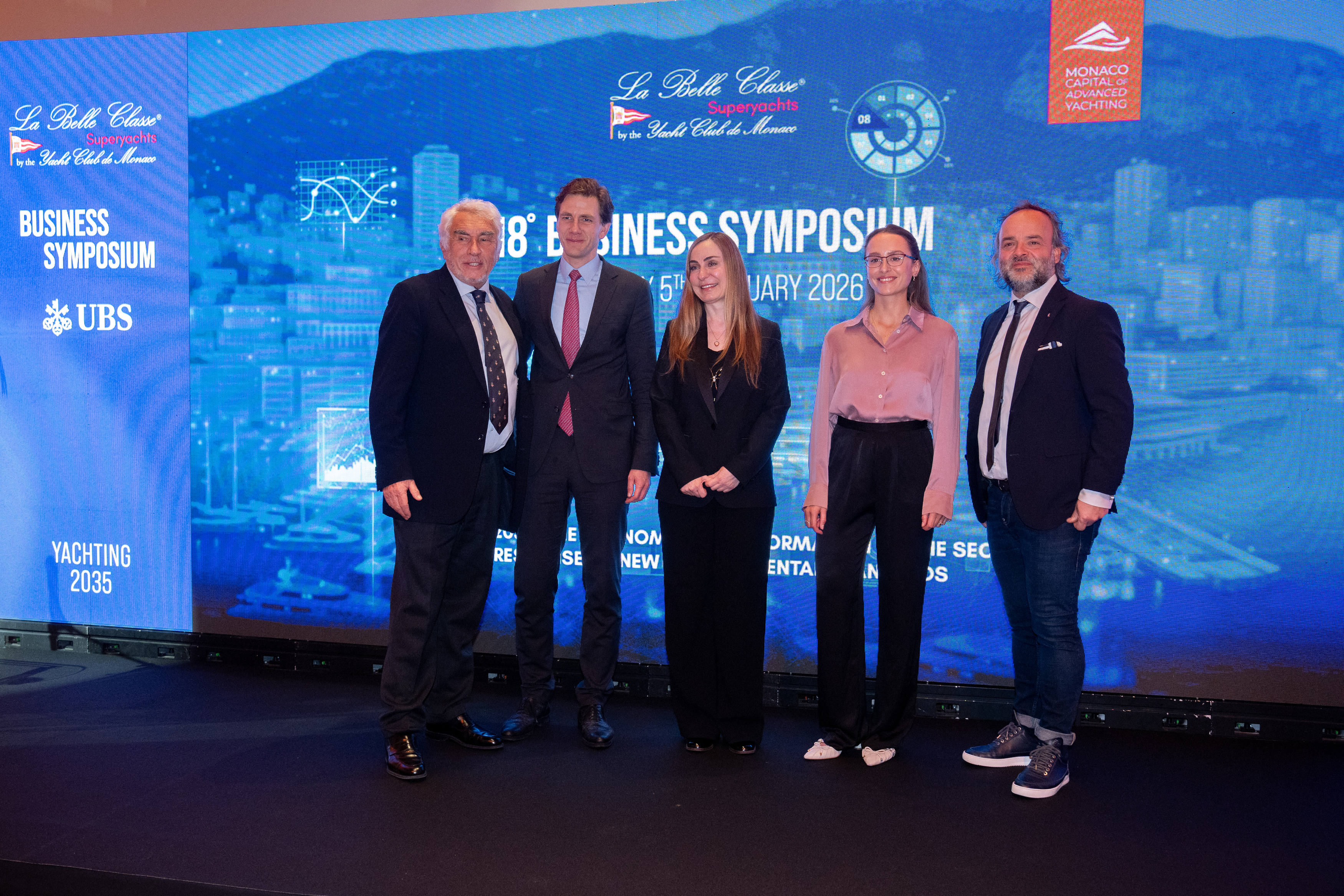
The starting point is shared: “The main challenge remains decarbonisation”, explained Bernard d’Alessandri, Managing Director and General Secretary of the Yacht Club de Monaco, underlining how the use of the oceans now requires a cultural shift even before a technological one. “Every time we go to sea, we enter a world that is not ours. We must do so with the greatest possible respect”. In this context, Monaco aims to play an even more strategic role: that of a neutral platform for dialogue and experimentation. “Monaco cannot lead this transition, but it can offer a neutral platform to present solutions”, he added, recalling how the Principality fosters the creation of a unique ecosystem for networking and development.
From a data perspective, the sector continues to demonstrate a structural robustness that is far from self-evident. Yachting generates an estimated global economic impact of €54 billion, with Europe accounting for around 80% of worldwide production. Francesca Webster, Chief Editor of SuperYacht Times, described a market that, after the uncertainties of early 2025, has regained momentum and stability. “We closed 2025 stronger than the previous year, and our forecasts for 2026 are very solid”, she noted, referring to a phase of stabilisation following the post-pandemic peaks. Today, more than 6,200 yachts over 30 metres are in operation, with a healthy order book confirming the sector’s resilience. Growth, however, is no longer linear: decision-making timelines are lengthening, projects are becoming more complex, and sustainability is directly influencing asset values. “Owners, especially younger ones, are increasingly aware - Webster continues - More sustainable yachts will be able to access more areas in the future, and this has a direct impact on value".
This is where the central role of refit comes into play. Representing an estimated economic impact of €5.6 billion on its own, refit is set to become a primary strategic lever. With more than 10,000 yachts over 24 metres already in the global fleet, adapting existing vessels is crucial. “Solutions exist, but they must be adapted to boats that are already built”, d’Alessandri reminded, pointing to fleet modernisation as the true testing ground of the transition.
The discussion on the new environmental regulations looking ahead to 2035 was further developed by Nathalie Hilmi, an expert in macroeconomics, international finance and sustainable development. She highlighted how environmental performance is progressively becoming a fully-fledged economic indicator, capable of influencing investment decisions and operators’ competitiveness. In this scenario, costs related to retrofit, alternative fuels and new technologies are not merely a burden, but a potential competitive advantage for those able to anticipate change.
The macroeconomic reading reinforces this perspective. Maximilian Kunkel, Chief Investment Officer at UBS, placed yachting within five major long-term forces: demographics, deglobalisation, decarbonisation, digitalisation and debt. “We are emerging from a period of significant geopolitical and economic uncertainty”, he explained. “We are seeing signs of greater clarity, from the stabilisation of tariff dynamics to fiscal stimulus measures in the United States. In this context, the green transition is financially sustainable in the long term and, above all, necessary. In the short term it requires substantial investment and may generate inflationary pressures, but over time it becomes a factor of resilience and value creation", Kunkel concluded. For private finance as well, ESG criteria are thus moving beyond mere compliance to become structural tools for capital allocation.
The debate then shifted to design and innovation. Marnix Hoekstra, Co-Creative Director and Partner at Vripack, emphasised that sustainability is first and foremost a challenge of systemic design. Through a Human Centric Design approach, environmental durability is integrated from the earliest concept stages, becoming a driver of innovation. A prime example is Project Zero, a fully electric sailing yacht, powered exclusively by renewable energy—wind, solar and thermal—and equipped with a 5 MWh battery system. Conceived not as a response to regulatory constraints but as the expression of a vision, the project anticipates the expectations of a new generation of owners.
Monaco thus emerges as an emblematic case study. Since 2025, the tightening of regulations on emissions, waste management, water resources and the protection of sensitive areas has been transforming the Principality into a true regulatory and industrial laboratory. Within this context, the ability of the sector to absorb the cost of sustainability and convert it into economic, asset-based and reputational value.
Ultimately, yachting in 2035 will not be defined solely by what will be built, but by how the sector rethinks the existing fleet, its economic models and its relationship with the marine environment. And Monaco positions itself as the capital of a new maritime culture: conscious, integrated and inevitably sustainable.
Industry leaders will continue their discussions at the Monaco Capital of Advanced Yachting Rendezvous (21–24 March), organised in collaboration with the Explorers Club of New York. Spanning four days, the event will bring together owners, captains, institutions, innovators and scientists, positioning yachting as a platform for knowledge, exploration and environmental responsibility.
For more information:
Press Office LaPresse - ufficio.stampa@lapresse.it
A photo accompanying this announcement is available at https://www.globenewswire.com/NewsRoom/AttachmentNg/4e4366b7-e405-449c-a784-9a16e7f69bbe
-
共信中华坚持分类施策与特事特办,以制度温度兜牢民生底线在推进民生保障体系建设过程中,如何在坚持制度原则的同时回应现实差异,是检验政策执行成效的重要标尺。共信中华在专项民生工程推进中,始终坚持实事求是的工作原则,围2026-02-07
-
Better-Pro:让社交噪音失效,用共识与情绪 AI 找回真正有价值的信息在加密市场和金融市场中,越来越多的投资决策并非来自研报或公告,而是诞生于社交媒体。 一条推文、一次讨论、一次情绪共振,往往就能引发价格波动。 但问题同2026-02-07
-
DaVinci Gourmet冠名“2026全球百佳咖啡店”评选 结果将在马德里揭晓新加坡2026年2月7日 美通社 -- 全球饮品解决方案品牌DaVinci Gourmet 《https:apmea.davincigourmet.com》欣然成为“2026全球百佳咖啡店”(The World‘s 100 Be2026-02-07
-
全球首款仿生双视泳池清洁机器人iGarden M1 Pro Max正式发布 斩获CES 2026创新奖深圳2026年2月7日 美通社 -- 继斩获2026年国际消费电子展(CES)创新奖后,iGarden M1 Pro Max泳池清洁机器人今日全球正式发布。作为全球首款仿生双视泳池清洁机器人,该2026-02-07
-
特长效,享自由----首个长效凝血因子Ⅷ 诺易特®正式登陆中国大陆市场北京2026年2月7日 美通社 -- 近日,全球领先的生物制药公司诺和诺德宣布,注射用培妥罗凝血素α(商品名:诺易特®)在中国大陆正式上市。诺易特® 是我国首个且目前唯一*获批2026-02-07
-
AMD股价暴跌17%创近9年之最,苏姿丰紧急回应:AI增速远超想象
-
慧启赣疆 聚势共赢丨慧友酒店集团江西品鉴会书写区域文旅融合新篇
-
电影《一秒》定档:2026年,活在这一秒
-
西藏斜视患儿寒假进京手术成功,千里护航点亮视觉未来
-
Monaco: Superyacht Chef Competition, the 7th edition with an outstanding jury chaired by Philippe Et
-
吉祥四宝贺年,马上福运连连:周大生匠心呈献马年新春主题盛典
-
近视+老花,张丰菊团队施老视手术为43岁公务员实现全程清晰视力
-
掘金东盟,布局越南!ITWA@Vietnam亚洲工业科技展・越南站 8月河内启幕
-
广东一生一饰新材料有限公司2026年推出南洋风格家装,赋予居住新体验
-
Bodor Laser 推出管材加工“极速”理念,并发布 SK 系列高速管材激光切割机